In defense of the curve
You walk into a space and something in you softens before you can explain it.
The light feels right. Not bright, not dim—just present.
Nothing is abrupt. Nothing interrupts you. Your body settles without asking permission.
And then there are spaces that are just as “beautiful,” just as considered—yet you remain slightly tense inside them. You notice everything, but you don’t feel held by anything.
So what makes a space feel like somewhere you can exist fully?
For a long time, human spaces were not designed to impress.
They were shaped by climate, by materials, by the rhythm of the day. Light entered naturally, surfaces aged, and nothing was entirely rigid.
There was a quiet continuity between the inside and the outside.
And within that continuity, form followed a logic adaptation, of gradual change, and, of movement.
Today, that continuity is often interrupted. In the pursuit of clean aesthetics, many interiors have become sharper, more controlled, more reduced. And while there is beauty in simplicity, something subtle has shifted.
Because calm does not come from emptiness. It comes from alignment.
What we now understand through the Biophilia Hypothesis is that humans are not neutral to their environments. We are deeply responsive to them.
Light regulates how we feel.
Materials affect how we perceive warmth and safety.
And shapes—almost invisibly—guide our emotional state.
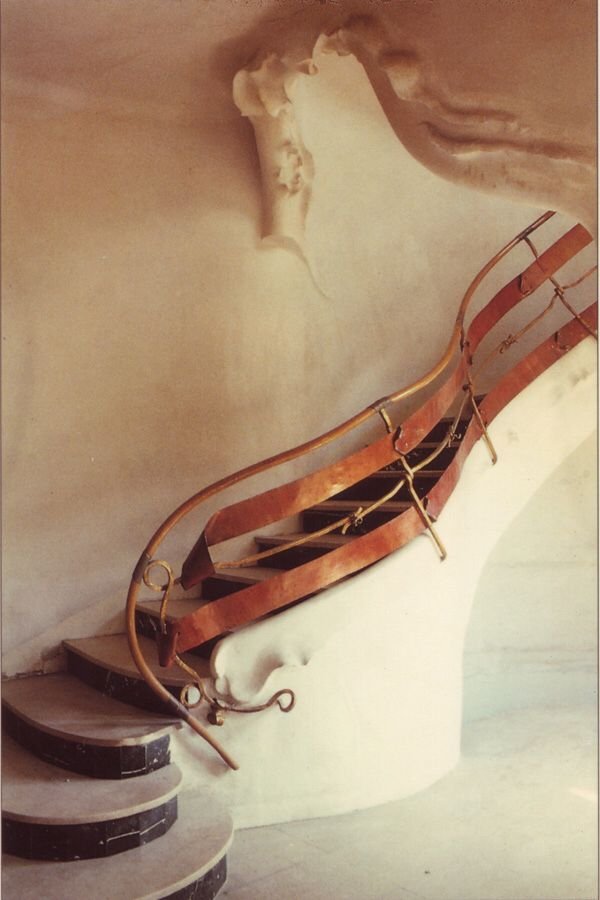
Gaudi. Barcelona
Curves, more than any other form, have a quiet authority in a space.
They do not draw attention to themselves in an obvious way, yet they change everything. A curved line does not interrupt the eye—it guides it. It creates continuity where a straight edge would create a stop.
This is part of why spaces shaped with softer geometries tend to feel more natural. Not because they imitate nature literally, but because they follow the same logic. In nature, very little exists in perfect straight lines. Growth expands, bends, adapts. Movement is never abrupt.
A curve carries that same quality into a space.
It suggests progression rather than division.
An arched opening softens the transition between two rooms.
A rounded corner removes the subtle tension of a sharp edge.
A curved piece of furniture invites the body rather than positioning it.
These are small gestures, but they reshape the experience entirely.
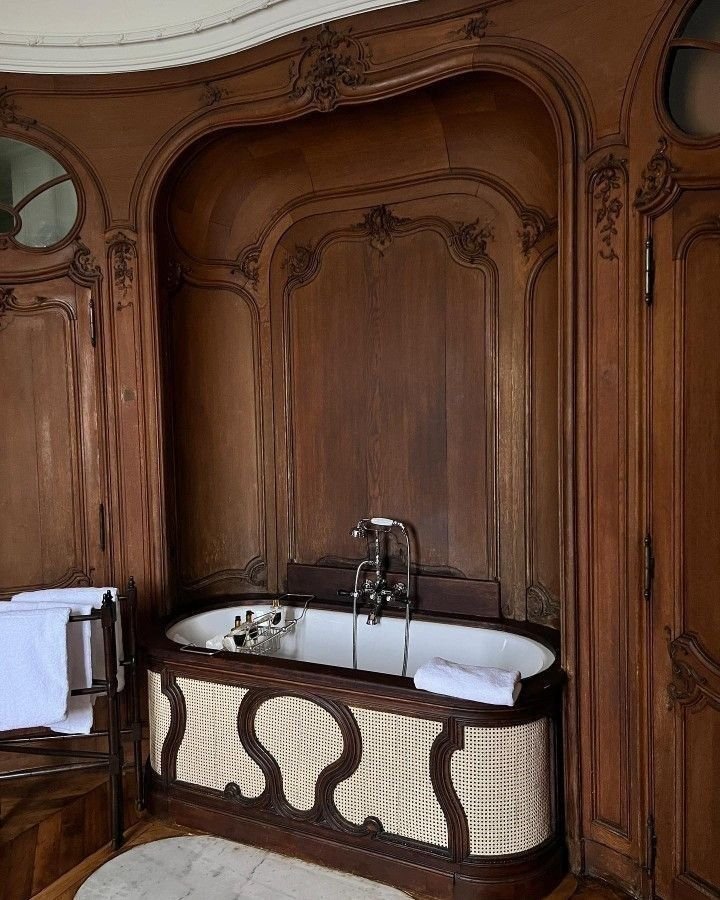
Abbaye des Vaux-de-Cernay (France) | Bathroom | Horus
There is also a form of elegance that belongs specifically to curves.
Not decorative elegance, but structural elegance—the kind that feels effortless.
A straight line can feel precise, even strict. It defines clearly, but it can also limit. A curve, on the other hand, introduces flexibility. It allows space to feel less constructed, more composed.
This is where proportion becomes important. When curves follow natural relationships—similar to those found in the Fibonacci Sequence or expressed through the Golden Ratio—they don’t feel excessive or ornamental. They feel inevitable.
As if they could not have been otherwise.
That is what gives them their elegance.
Not complexity, but coherence.
In contrast, when a space is built entirely on straight lines and sharp angles, it becomes highly defined, but also more static. The eye moves in segments. The body registers boundaries more sharply.
Over time, this can create a subtle sense of rigidity.
Curves soften that rigidity without removing structure.
They introduce flow without creating disorder.
They allow a space to hold both clarity and ease at the same time.
This is where design moves beyond aesthetics and into experience.
Through what is explored in Neuroaesthetics, we begin to understand that our response to space is not only visual, but physiological. We are constantly reading our environment—looking for signals of comfort, continuity, and ease.
And we respond, often without noticing, to what allows us to relax into it.
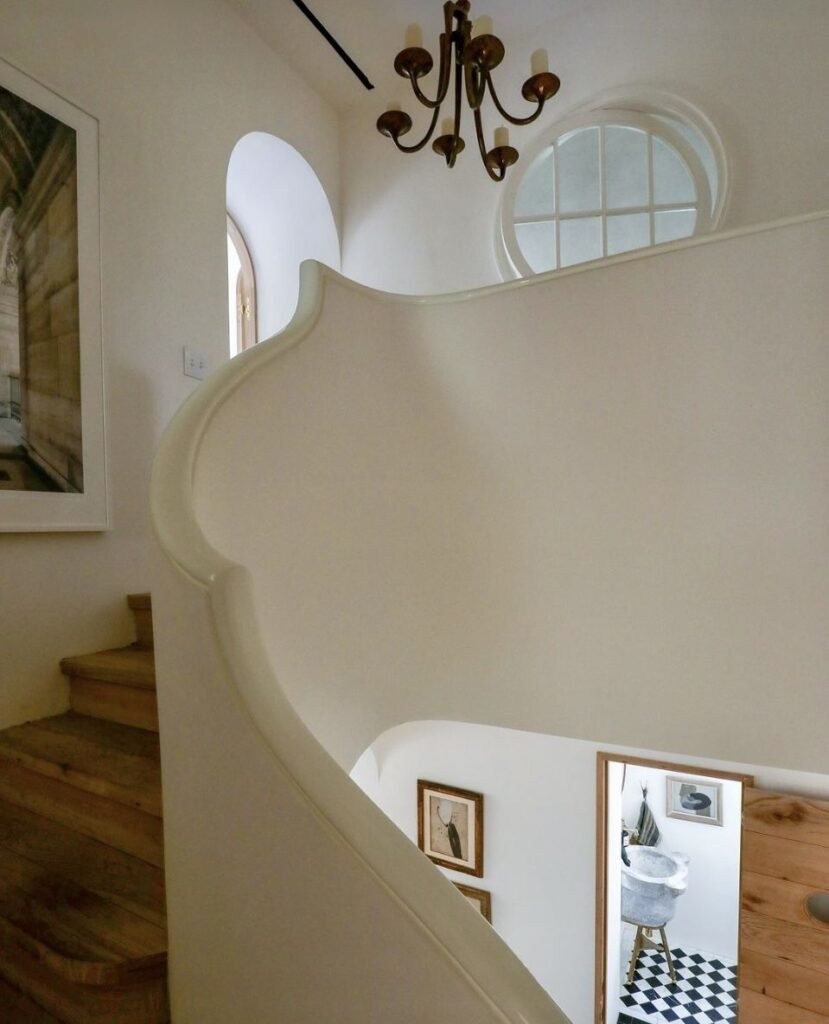
Interiors by Paul Bates Architects
A home that feels right is not one that is perfectly composed.
It is one that allows for flow.
A slight curve instead of a strict line.
A transition that feels natural rather than abrupt.
A space that carries you from one moment to the next without resistance.
These are small decisions, but they accumulate into something larger.
In the end, good living is not about aesthetic perfection.
It is about creating an environment that the body trusts.
An environment that does not interrupt you, but supports you.
And often, that comes down to something very simple:
Not less design, but softer design.
Not emptiness, but continuity.
Not rigidity, but form that follows the quiet logic of life itself.
Because a space should not only be seen. It should be lived in—fully, comfortably, and without effort.
And more often than not, it is the curve that allows that to happen.
Author: Khaoula El Hadri